

Propofol
Propofol
Pharmacology, pharmacokinetics, pharmacodynamics, clinical use, TIVA, haemodynamic effects, adverse effects, PRIS and postgraduate viva points.
Propofol at a Glance
Propofol is a highly titratable intravenous hypnotic used for induction and maintenance of general anaesthesia, procedural sedation and selected intensive-care applications. Its rapid onset and recovery characteristics make it particularly useful for TIVA. Its major clinical limitations include dose-dependent cardiovascular and respiratory depression and the absence of reliable analgesia.
Key Pharmacology
Mechanism of Action
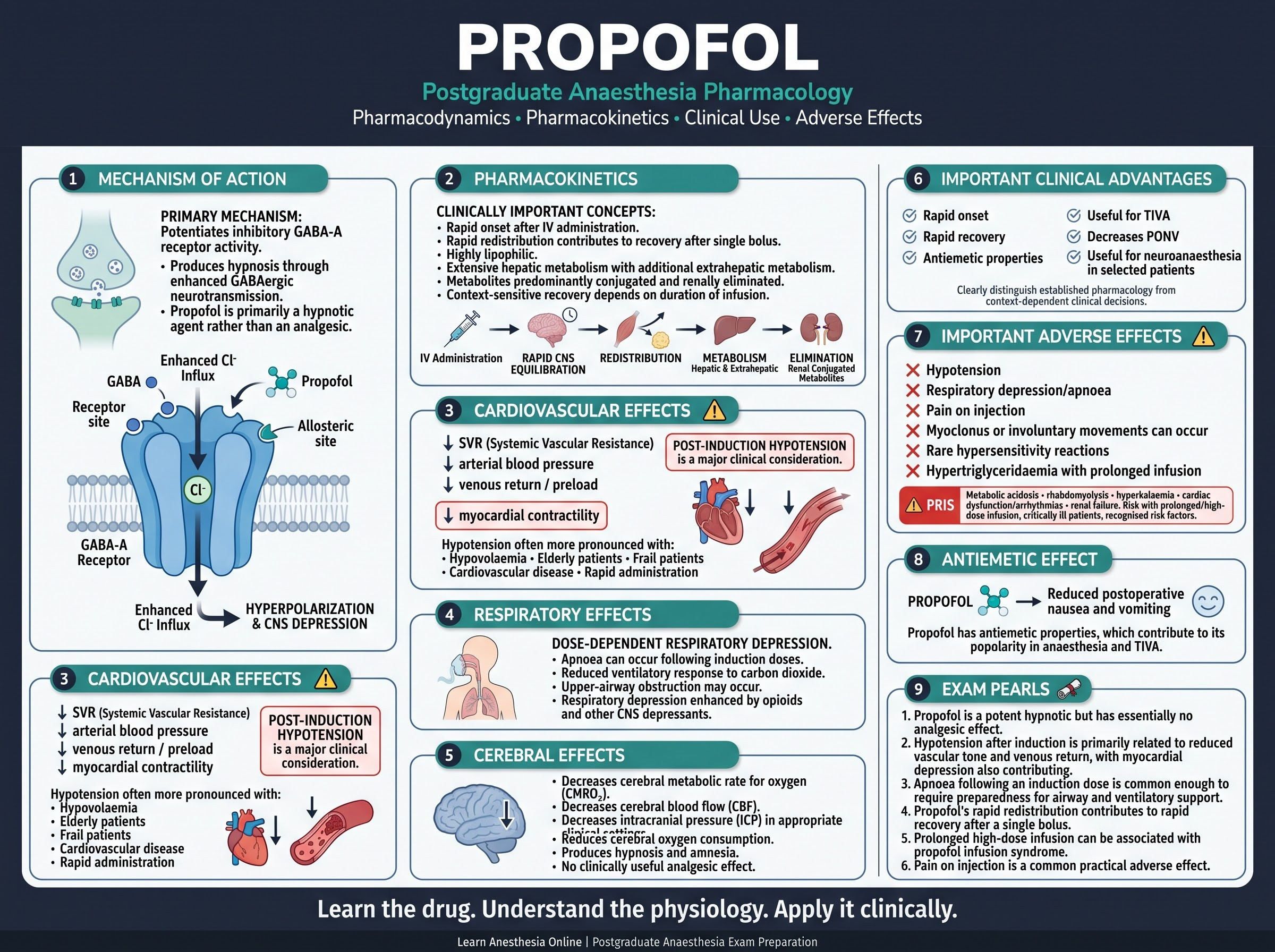
Propofol produces hypnosis predominantly by enhancing inhibitory neurotransmission mediated through GABAA receptors. At clinically relevant concentrations it facilitates GABA-mediated chloride conductance and neuronal inhibition within the central nervous system.
The clinical effects are concentration dependent. Increasing effect-site concentrations progress from sedation through loss of consciousness, with increasing impairment of airway reflexes and ventilatory drive at deeper levels of anaesthesia.
Propofol should not be considered an analgesic. For painful procedures, analgesia should be provided using an appropriate opioid, regional technique, local anaesthetic or other analgesic strategy according to the clinical context.
Pharmacokinetics
After intravenous administration, propofol rapidly equilibrates with the brain and other highly perfused tissues, producing loss of consciousness within a short period. Following a single bolus, recovery is initially dominated by redistribution away from the effect site.
Propofol demonstrates multi-compartment pharmacokinetics. With repeated doses or prolonged infusion, peripheral compartment uptake and subsequent redistribution become increasingly important in determining recovery.
Clearance occurs predominantly through hepatic metabolism, with additional extrahepatic clearance contributing to overall elimination. Metabolites are largely excreted renally.
Pharmacokinetics & Pharmacodynamics: Viva Level
| Concept | Clinical relevance |
|---|---|
| Effect-site equilibration | Plasma concentration and clinical effect do not change simultaneously; an effect-site compartment is useful when describing the time course of hypnotic effect. |
| Redistribution | Important contributor to early recovery following a single bolus. |
| Context-sensitive recovery | Recovery following prolonged infusion is influenced by duration of administration and redistribution from peripheral compartments. |
| TCI | Target-controlled infusion uses pharmacokinetic models to target a predicted plasma or effect-site concentration and facilitates titration of intravenous anaesthesia. |
Cardiovascular Effects
Propofol commonly produces a reduction in arterial blood pressure following induction. The dominant mechanism is usually a reduction in systemic vascular resistance, with additional effects on myocardial contractility and venous capacitance contributing in susceptible patients.
The fall in arterial pressure may be exaggerated by hypovolaemia, advanced age, autonomic dysfunction, impaired ventricular function, sepsis or concomitant vasodilating and sympatholytic drugs.
Respiratory Effects
Propofol produces dose-dependent depression of ventilatory responses and can cause transient apnoea following induction. Upper-airway muscle tone and protective airway reflexes are also reduced as anaesthetic depth increases.
Respiratory depression is more pronounced when propofol is combined with opioids, benzodiazepines or other central nervous system depressants. Appropriate airway equipment, oxygenation and ventilation support should therefore be immediately available when administering induction or deep sedation doses.
Common Clinical Dosing
| Clinical situation | Typical adult range / approach | Postgraduate consideration |
|---|---|---|
| Induction of GA | Approximately 1.5–2.5 mg/kg IV in a healthy adult | Titrate to effect. Consider substantially lower requirements in elderly, frail, hypovolaemic or haemodynamically unstable patients. |
| Procedural sedation | Small titrated boluses or infusion | Depth of sedation, procedure, airway risk and co-administered analgesics determine requirements. |
| TIVA | Continuous infusion or TCI | Dose is determined by target concentration, patient factors, co-administered analgesia and monitoring of anaesthetic depth. |
Propofol in TIVA
Propofol is one of the principal hypnotic agents used for total intravenous anaesthesia. Its pharmacokinetic characteristics allow infusion-based titration, while its effect can be combined with short-acting opioids or other analgesic techniques.
In modern TIVA practice, drug delivery may be controlled manually or by target-controlled infusion systems. Effect-site targeting attempts to account for the delay between plasma concentration and clinical effect.
Depth of Anaesthesia & EEG
Propofol produces characteristic dose-dependent changes in the EEG as anaesthetic depth increases. Processed EEG indices such as BIS may assist titration during TIVA, but they should be interpreted alongside clinical signs, haemodynamics, drug delivery and the overall anaesthetic context.
Processed EEG monitoring should therefore be viewed as an adjunct rather than a substitute for clinical assessment and appropriate monitoring.
Clinical Uses
- Induction of general anaesthesia
- Maintenance of general anaesthesia as part of TIVA
- Target-controlled intravenous anaesthesia
- Procedural sedation
- Selected intensive-care sedation under appropriate monitoring
- Short procedures where rapid recovery is desirable
Clinically Useful Properties
- Rapid onset of hypnosis
- Highly titratable intravenous administration
- Useful for TIVA and TCI techniques
- Generally favourable recovery after short-duration administration
- Antiemetic properties
- May be associated with reduced postoperative nausea and vomiting compared with some alternative anaesthetic approaches
Antiemetic Properties
Propofol has clinically relevant antiemetic properties. The reduction in postoperative nausea and vomiting observed with propofol-based techniques is one reason it is attractive in patients in whom postoperative recovery and PONV are important considerations.
Pain on Injection
Pain on intravenous injection is a common and characteristic adverse effect of propofol. The incidence varies with the formulation, injection site and technique.
Evidence supports several strategies for reducing injection pain, including use of a larger antecubital vein and administration of lidocaine with or before propofol in appropriate circumstances. A large systematic review found antecubital venous access and lidocaine with venous occlusion to be particularly effective approaches.
Adverse Effects
Cardiovascular
Hypotension, reduced systemic vascular resistance and, in susceptible patients, myocardial depression and impaired compensatory responses.
Respiratory
Respiratory depression, apnoea, airway obstruction and reduced airway reflexes, particularly at deeper levels of anaesthesia.
Injection pain
Common and influenced by injection site, formulation and preventive measures.
Other
Myoclonus-like or involuntary movements, pruritus and other transient phenomena may occur. Rare serious complications include PRIS.
Special Patient Groups
| Patient group | Anaesthetic consideration |
|---|---|
| Elderly / frail | Increased sensitivity and reduced physiological reserve often require lower, slower and carefully titrated dosing. |
| Hypovolaemia | Hypotension may be pronounced; assess and optimise the underlying physiology where appropriate. |
| Cardiac dysfunction | Reduced cardiovascular reserve increases the consequences of vasodilation and myocardial depression. |
| Obesity | Dosing strategy should consider pharmacokinetic scaling, clinical response and the intended endpoint rather than applying body weight indiscriminately. |
Continue Learning
Build your anaesthesia pharmacology knowledge with related topics, exam-focused practice and viva preparation.